- Degree
- M.Sc. Software Engineering, AI and NLP, Braude Academic College
- When
- 2021 to 2023
- Built with
 Python
 TensorFlow
 NumPy
 Matplotlib
 Isolation Forest
 Dynamic Time Warping
Who it is for
Researchers of old Arabic texts, where the author credited on a book is sometimes doubtful.
What I built
A pipeline of small neural networks, one for every pair of known authors, that turns each book into a style signal and flags the books that do not fit.
How it works
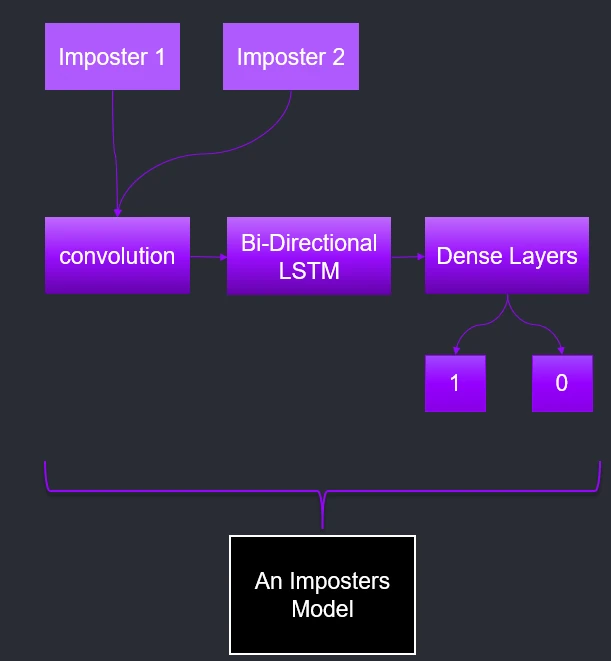
- For every pair of known authors, train a small network that tells their writing apart: convolution, a bi-directional LSTM, then dense layers.
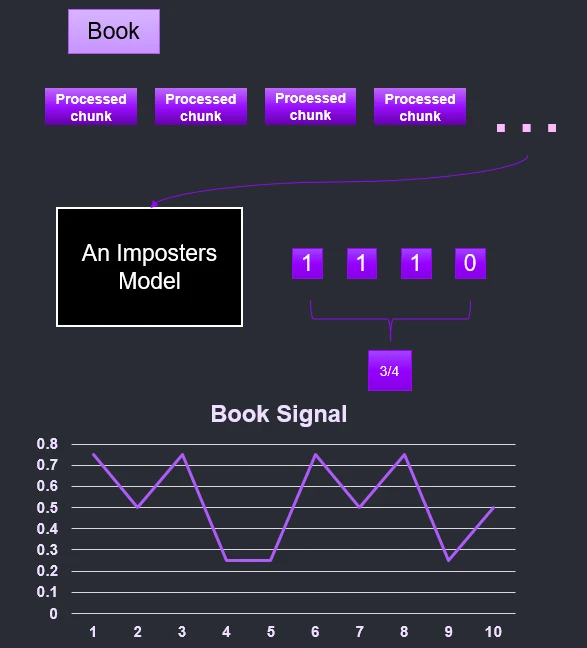
- Cut each book into 2,048-character chunks. Each network votes on every chunk, and the votes are averaged in groups of 4, so each book becomes one signal line.
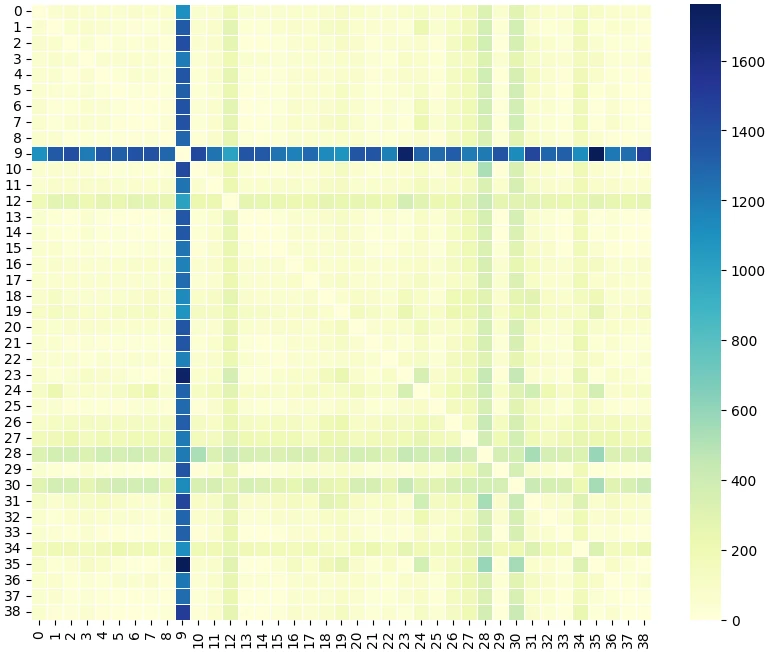
- Compare every two books' signals with Dynamic Time Warping, a way to measure how alike two wavy lines are: one distance table per network.
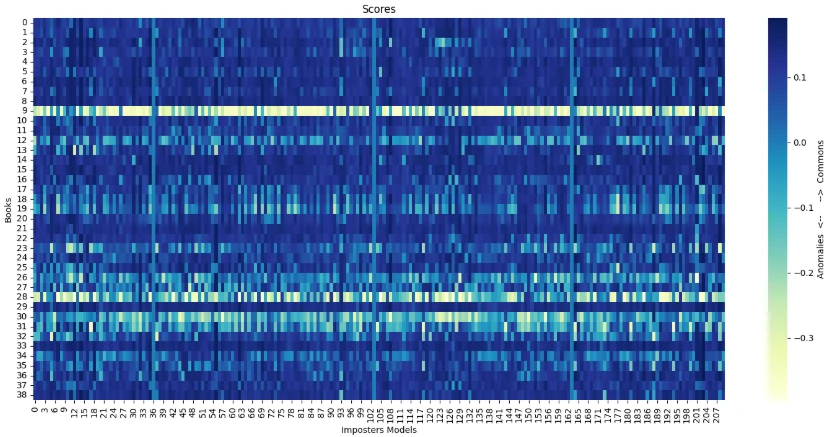
- An outlier detector, Isolation Forest, gives each book an anomaly score per network.
- Plot all the scores: books that stand out across most networks are the doubtful ones.
What you can see today
The method and its real figures, here. The early data-processing step is public on GitHub.